
Collection Spotlight – Friedrich Eser’s Dysodil Fossils
In the spring of 2024, while deciding which portion of the HUPB collection to inventory and rehouse next, the paleo team came across a set of very unusual specimens preserved in a sediment called dysodil. These specimens were similar to paper shales – fine-grained, brittle, delaminating, only a few millimeters thick – but oddly, they were glued to sheets of paper and housed in stacks inside large book covers. This was an unusual find for a collection that is made up primarily of solid chunks and slabs of shale, sandstone, and ironstone. The specimens needed attention badly. They were detaching from their paper, cracking, broken, and in some cases moldy from water damage. This made them the perfect candidate for a dedicated rehousing project. First, though, we needed to understand what these fossils were and where they came from.

The Randeck Maar near Kirchheim unter Teck in southern Germany is an early- to mid-Miocene fossil lagerstätte with particularly well preserved plants and animals (1, 2). These organisms were preserved deep in a volcanic crater lake where there was little oxygen and little water movement. These conditions enabled very fine layers of calcareous and bituminous sediment to settle on fallen vegetation and preserve them in detail. This fossil-rich substance is called dysodil. Before excavation, dysodil is wet, soft, and pliable, but once it is exposed to the air and dries, it becomes extremely brittle. Because of this, it is very rarely found in collections. Somehow, despite their fragility and rarity, there are several hundred of these dysodil specimens in the HUPB collection.
So how did these extremely fragile specimens get from the ground in Germany to a collection at Harvard? In the early 1870s, Alpheus Hyatt, professor at MIT and Custodian of the Boston Society of Natural History (BSNH), travelled to Europe and acquired numerous paleontological specimens for the Society from Friedrich Eser, a German naturalist (3). Eser recounted his experience and the challenges he faced while collecting dysodil around 1870 in his memoir (4). Through trial and error, Eser came up with a method inspired by botanical collecting that kept the dysodil intact and stable: mounting the pieces on paper in the field, gluing them to cardboard, and pressing them in a plant press. Eser then sent his specimens to Swiss paleobotanist Oswald Heer for study. Once they were identified, the specimens went back to Eser where they were purchased by Hyatt using funds donated by John Cummings, a Massachusetts banker and Vice President of the BSNH. The specimens were received at the BSNH in 1873 where they remained for the next few decades.
In 1914, the mission of the BSNH changed and its focus shifted exclusively to New England natural history (5). To facilitate this shift, they donated much of their paleontological collections, including Eser’s dysodil, to the Museum of Comparative Zoology at Harvard. From there, these botanical specimens were transferred to the Botanical Museum and then became part of the Harvard University Herbaria in 1985 when the Botanical Museum dissolved.
We pieced this history together using the specimens’ labels and book covers, the ledgers of the BSNH in the archives of Boston’s Museum of Science, and various publications on the BSNH, Eser, and the Randeck Maar.
If these specimens were as unique as our research suggested, it was crucial that we come up with a rehousing plan to stabilize the dysodil and secure it for future study. When we first looked at the specimens, it was clear both books had been exposed to water by the warping, staining, and moldiness of the large paper sheets, though they were dry now. Additionally, the specimens were cracking and sometimes floating loose, no longer attached to the paper. They were stacked on top of each other, exacerbating the breakage and increasing the risk of losing specimen pieces. We also found several drawers of the same dysodil specimens that were not glued to paper or stacked, but were covered in dust and suffering damage from sliding around loose in boxes. None of this was conducive to long term stability.
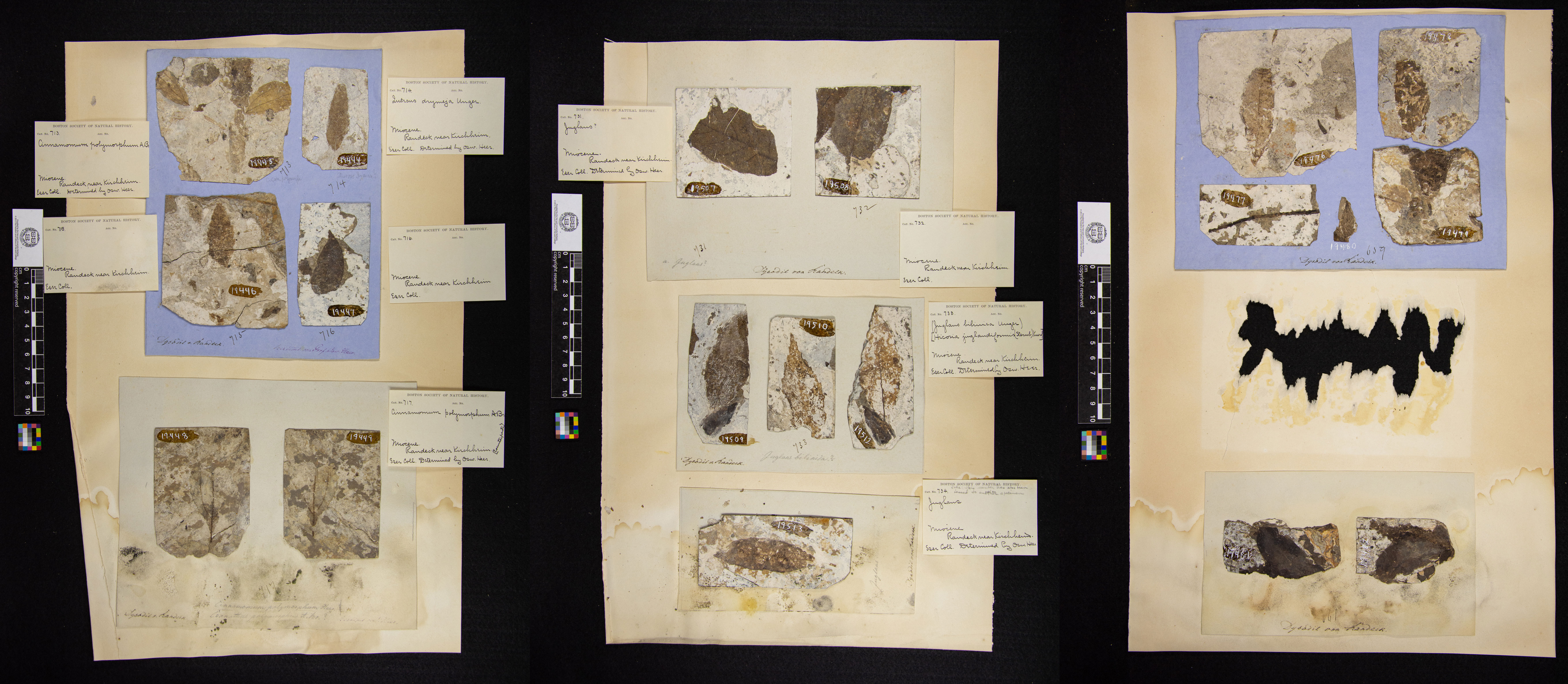
To eliminate further damage, we decided to separate the specimens from the moldy warped paper they were glued to and remove any mold from the specimens or cardboard. This was a difficult decision because it meant disassociating the specimens from their historical context in the books. To preserve the context, each page of the book was first imaged, and a condition report was written for the whole page and for each specimen. We then cut the specimens from the large paper sheets and used paintbrushes to gently brush any remaining mold into the nozzle of a HEPA filter vacuum on a low suction setting. We covered the nozzle of the vacuum with a fine tulle-like mesh to avoid accidentally vacuuming up any pieces of the dysodil. The mold was old and dry so we could remove it very easily, but it occasionally left surface stains behind. We used a similar technique to clean specimens that had a thick layer of dust on their surface.

Once the specimens were clean and imaged again, we needed to house them in a way that would provide a stable environment. Specifically, we wanted to avoid stacking them on top of each other and we wanted to prevent them from shifting around in their boxes. Our solution was to create a custom-cut bed of ethafoam for every dysodil specimen and place that within a closed archival specimen box. The ethafoam bed would keep the specimen in place and the box would protect it from dust and crushing. With a few customization options for odd cases, we now had a solution to keep these specimens safe.
We also needed to preserve the information with the specimens. Many of the book pages had handwritten notes on locality, determination, and determiner probably written by either Eser or Heer. This information was carefully transcribed into our digital records and copied onto new HUPB labels. The original handwritten information remained with the specimen. There were also loose historical labels from the BSNH and Eser or Heer associated with many of the specimens. These and the new HUPB labels were tucked into polyethylene sleeves and affixed to the top of each specimen’s box. When a box was too small for a label sleeve, a new label was typed and attached directly to the box and the full-size labels were stored nearby.
After several days committed entirely to preparing these special boxes, every piece of dysodil was safely rehoused. We updated each specimen’s condition report to reflect their improved housing and organized the boxes for easy accessibility. A complete inventory of the specimens is available on the HUPB page of this website and can be found by searching the word “Kirchheim” in the spreadsheet. The dysodil specimens have now returned to the collection, where they will safely remain in perpetuity.


Acknowledgements
We are very grateful for the extremely helpful discussions about paper, paper and stone damage, stone chemistry, vacuum cleaners, and general conservation advice from Danielle Castronovo, Eliza Spaulding, Debora Mayer, and Mei-An Tsu. We are also grateful to Brittany Contratto in the archives of the Museum of Science for help accessing and using BSNH archive material.
References
- Rasser, M.W., et al. (2013). The Randeck Maar: Palaeoenvironment and habitat differentiation of a Miocene lacustrine system. Palaeogeography, Palaeoclimatology, Palaeoecology, 392. 426-453. https://doi.org/10.1016/j.palaeo.2013.09.025.
- Rasser, M.W., et al. (2014). The Miocene Randeck Maar (SW Germany): Geological compilation and census of scientific excavations. Neues Jahrbuch für Geologie und Paläontologie – Abhandlungen, 274. 209-218. https://doi.org/10.1127/njgpa/2014/0436
- Hyatt, A. (1874). Custodian’s Report. Proceedings of the Boston Society of Natural History, 17. 1-11. https://www.biodiversitylibrary.org/page/41798656.
- Eser, F. (1907). Aus Meinem Leben. Published by Friedrich Alber. https://archive.org/details/EserAusMeinemLeben17981873.
- Johnson, R. I. (2009). The rise and fall of the Boston Society of Natural History. Northeastern Naturalist, 11. 81-108. https://www.jstor.org/stable/3858546.