
Digitization
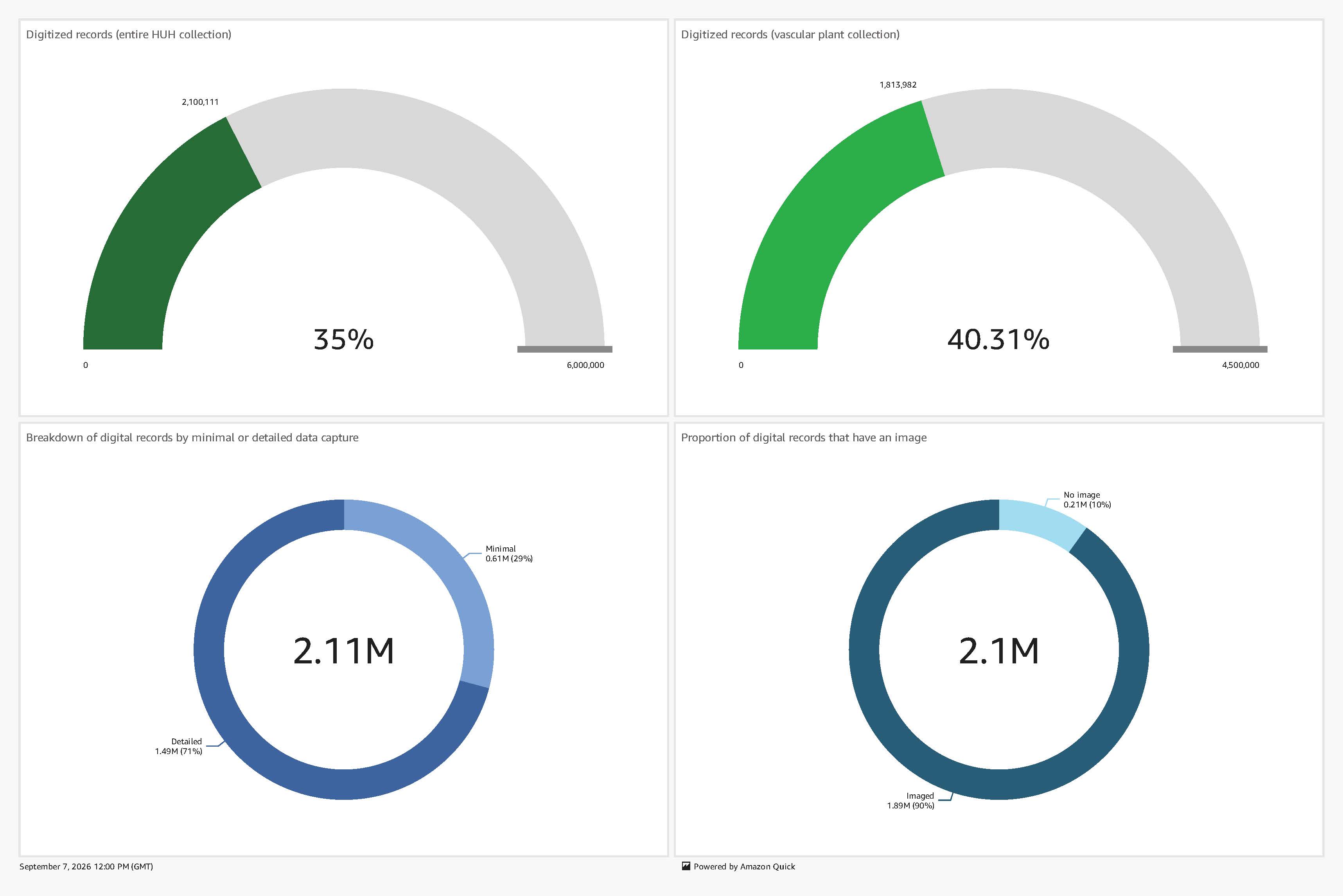
Digitization is a strategic priority for the continued care and use of Harvard University Herbaria’s archives and specimen collection. The HUH makes available the digital records and images for over 2 million specimens. In the graphs below, you can review our progress toward fully digitizing the HUH collection, including the number of records with complete data capture and imaging:
Where can I get HUH specimen records?
GBIF: Biodiversity researchers and other scholars wanting to search for data across multiple collections can make use of the Global Biodiversity Information Facility (GBIF). GBIF makes available over 247 million specimen records from thousands of institutions worldwide and another 300+ billion observation records. Records downloaded from GBIF can be conveniently cited for publication. HUH records can also be selectively searched using the “Publisher” field (Try here).
HUH databases: The HUH website offers three databases for: 1) HUH specimens, 2) known botanists, and 3) botanical publications. The specimen database can be used to search for digital records for HUH specimens. The botanists database is a list of known botanists curated by HUH staff and includes information about known collecting locations and taxonomic or geographic specialties. The publications database is a compendium of bibliographic references for botanical books, journals, and exsiccatae.
HUH IPT: The HUH IPT server makes specimen records available in DarwinCore format. Multiple feeds are available for downloading all HUH records or a subset based on taxonomic group, geography, or project.
Community portals: HUH contributes specimen records to numerous community portals with a taxonomic or geographic focus. Some of those portals include SEINet, SERNEC, Consortium of Northeastern Herbaria, MyCoPortal, Consortium of Bryophyte Herbaria, Consortium of Lichen Herbaria, Algae Herbarium Portal, All Asia TCN, and African Plants Portal.
Digitization at HUH, historical and ongoing
HUH was one of the first institutions to begin digitizing herbarium specimen metadata in the 1990’s. Our botanist and publication databases are key resources for the botanical community where authoritative sources of information are often lacking or not consistently maintained. HUH taxonomic metadata was foundational to establishing the International Plant Names Index in 2000 and staff continue to curate and contribute names to the index. Through the 2000’s, HUH partnered in the formation of nascent digitization initiatives aimed at generating photographic digital images of specimens and mobilizing specimen metadata online, such as the JSTOR Global Plants Initiative.
Since then, digitization has continued in earnest and has become a priority for herbaria around the world. HUH has partnered in multiple Thematic Collection Networks, funded by NSF, including:
Tropical Africa TCN (2022-2026)
All Asia TCN: Bringing Asia to digital life (Harvard led, 2021–2026)
TORCH TCN: American Crossroads, Texas and Oklahoma Plants (2019-2023)
Endless Forms TCN (2020-2024)
Southern Rocky Mountains TCN (2017-2021)
Microfungi Collections Consortium (2015 – 2018)
Macroalgal Herbarium Consortium TCN (2013 – 2017)
New England Vascular Plants TCN (2012-2016)
Macrofungi Collection Consortium (2012 – 2015)
North American Lichens and Bryophytes (2011-2015)
How does digitization at HUH work?

HUH faculty, staff, and fellows have been instrumental in advancing herbarium digitization technologies and workflows. Through the New England Vascular Plants TCN, the HUH pioneered a conveyor-belt system for the rapid imaging of herbarium sheets. A few years later, HUH innovated specimen imaging again by developing a flexible single-user photostation customized for the mass imaging of herbarium specimens. Along with an in-house application for rapid label transcription, this system has been used to digitize over 2 million specimens at HUH and more at partner herbaria.